CAPACI 23 MAY 1992
The day the State was challenged in blood.
The Capaci massacre was not just a Mafia attack. It was a turning point—an open declaration of war against the Italian State.
On May 23, 1992, at 5:58 PM, a section of the A29 highway near Capaci was ripped apart by a massive explosion just as the convoy escorting judge Giovanni Falcone was returning from Palermo airport. The blast was so powerful that it destroyed a large portion of the road, sending concrete, debris, and vehicles into the air, leaving behind a scene of devastation visible from miles away.
The attack was not improvised. It had been carefully prepared over time. Hundreds of kilograms of explosives had been placed in a tunnel beneath the highway and connected to a remote detonation system. The moment Falcone’s convoy passed over the exact point, the device was activated with precision.
Inside the lead car were the escort officers. In the second vehicle was Giovanni Falcone, driving himself, with his wife, magistrate Francesca Morvillo, seated beside him. Within seconds, the explosion wiped out the convoy. The impact killed Falcone, Morvillo, and three members of the escort: Antonio Montinaro, Rocco Dicillo, and Vito Schifani.
What remained was not only destruction, but a message.
The Capaci massacre showed that Cosa Nostra was no longer operating in the shadows alone. It was willing to strike openly, with military-level force, in a public space, in broad daylight. This was not just an assassination. It was a demonstration of power, designed to challenge the authority of the State and to show that even its most protected figures were vulnerable.
In that moment, the hidden conflict between the Mafia and the Italian State became visible to everyone.
nside the armored cars were Giovanni Falcone, his wife Francesca Morvillo, and the officers assigned to protect them. In a matter of seconds, the road collapsed, vehicles were thrown into the air, and the scene turned into devastation. What had been an ordinary return from the airport became a point of no return.
Falcone and Morvillo were in the second car. The impact was immediate and overwhelming. The vehicle was crushed by the force of the explosion, leaving no real possibility of escape. Around them, the escort cars were torn apart, their structure unable to withstand the scale of the blast.
Antonio Montinaro, who led the escort, died instantly. Vito Schifani and Rocco Dicillo, also part of the protection detail, were fatally injured. In those moments, the line between duty and sacrifice disappeared completely. They were not just officers carrying out an assignment, but men placed directly in the path of a calculated act of destruction.
The aftermath was marked by confusion, smoke, and silence broken only by the first emergency responses. Survivors and rescuers arrived to a scene that no longer resembled a road, but a crater. Pieces of vehicles were scattered across the area, and the scale of the damage made it immediately clear that this was something unprecedented.
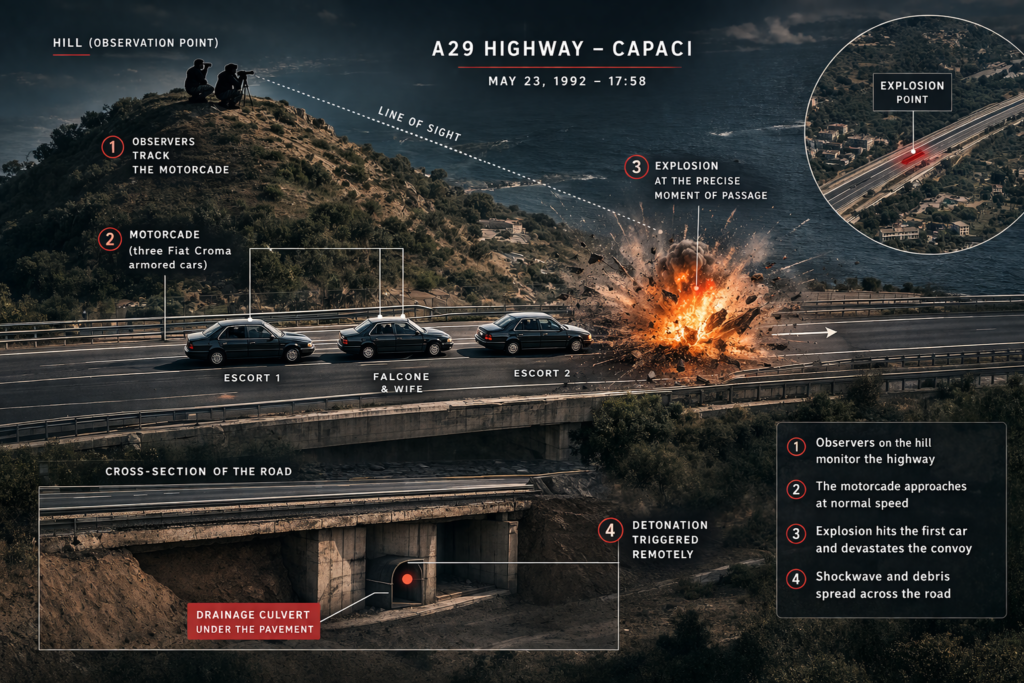
The consequences of the Capaci massacre went far beyond the destruction of that moment. It marked a definitive rupture between Cosa Nostra and the Italian State, transforming a hidden conflict into an open confrontation. What had once been fought through investigations and courtrooms was now answered with explosions and public violence.
The killing of Giovanni Falcone was not only the elimination of a magistrate, but an attempt to destroy a method. Falcone had shown that the Mafia could be understood, studied, and dismantled as a system. By killing him, Cosa Nostratried to erase that progress and reassert control through fear.
Instead, the opposite happened.
The shock of the attack forced institutions and public opinion to react. The image of the destroyed highway became a symbol that could not be ignored. In the weeks that followed, pressure on the State increased, and the fight against the Mafia entered a new phase—more direct, more visible, and more urgent.
But the violence did not stop. Just fifty-seven days later, the Mafia struck again, killing Paolo Borsellino in the Via D’Amelio massacre. The sequence of attacks made it clear that the strategy was not isolated, but part of a broader plan to challenge the State at its core.
Today, the Capaci massacre remains one of the most defining moments in modern Italian history. It represents the point at which the Mafia revealed its true strength, but also the point at which its actions became impossible to ignore.
It was meant to intimidate.
Instead, it exposed everything.
During the funeral of the victims of the Capaci massacre, the pain of that day found a voice.
She was the wife of one of the officers who died protecting Giovanni Falcone.
“Addressing the men of the Mafia, she said: “I forgive you… but you must get down on your knees.”
The attack in Capaci was not the end.
Just 57 days later, Cosa Nostra struck again in Palermo.
This is not just history.
Add your voice. Ask a question. Share a thought.
Quick Facts
Killed in the Capaci massacre:
Giovanni Falcone — Magistrate
Francesca Morvillo — Magistrate, Falcone’s wife
Antonio Montinaro — Police officer (escort leader)
Vito Schifani — Police officer
Rocco Dicillo — Police officer