Via Pipitone Massacre
The attack that killed Judge Rocco Chinnici
The Via Pipitone Bombing
This footage shows the immediate aftermath of the bombing that killed
:contentReference[oaicite:0]{index=0},
one of the first magistrates to understand that the Mafia was not just a criminal organization,
but an economic system deeply rooted in society.
In the video, the judge speaks openly about a reality many preferred to ignore:
a large part of Palermo’s economy was tied to drug trafficking.
The attack also killed two carabinieri, Mario Trapassi and Salvatore Bartolotta,
along with a civilian, Stefano Li Sacchi.
This was one of the first major car bomb attacks carried out by Cosa Nostra.
The assassination of Rocco Chinnici was one of the first major Mafia bombings that revealed the true nature of Cosa Nostra’s war against the State.
At dawn, in Palermo, on Via Pipitone Federico, a car packed with explosives detonated outside a residential building, killing Rocco Chinnici, a magistrate who had begun to understand that the Mafia was not a series of isolated crimes, but a single, organized system rooted in power and economics. Alongside him died his escort officers, Salvatore Bartolotta and Mario Trapassi, and Stefano Li Sacchi, the building’s porter, an ordinary man caught in an act of targeted violence.
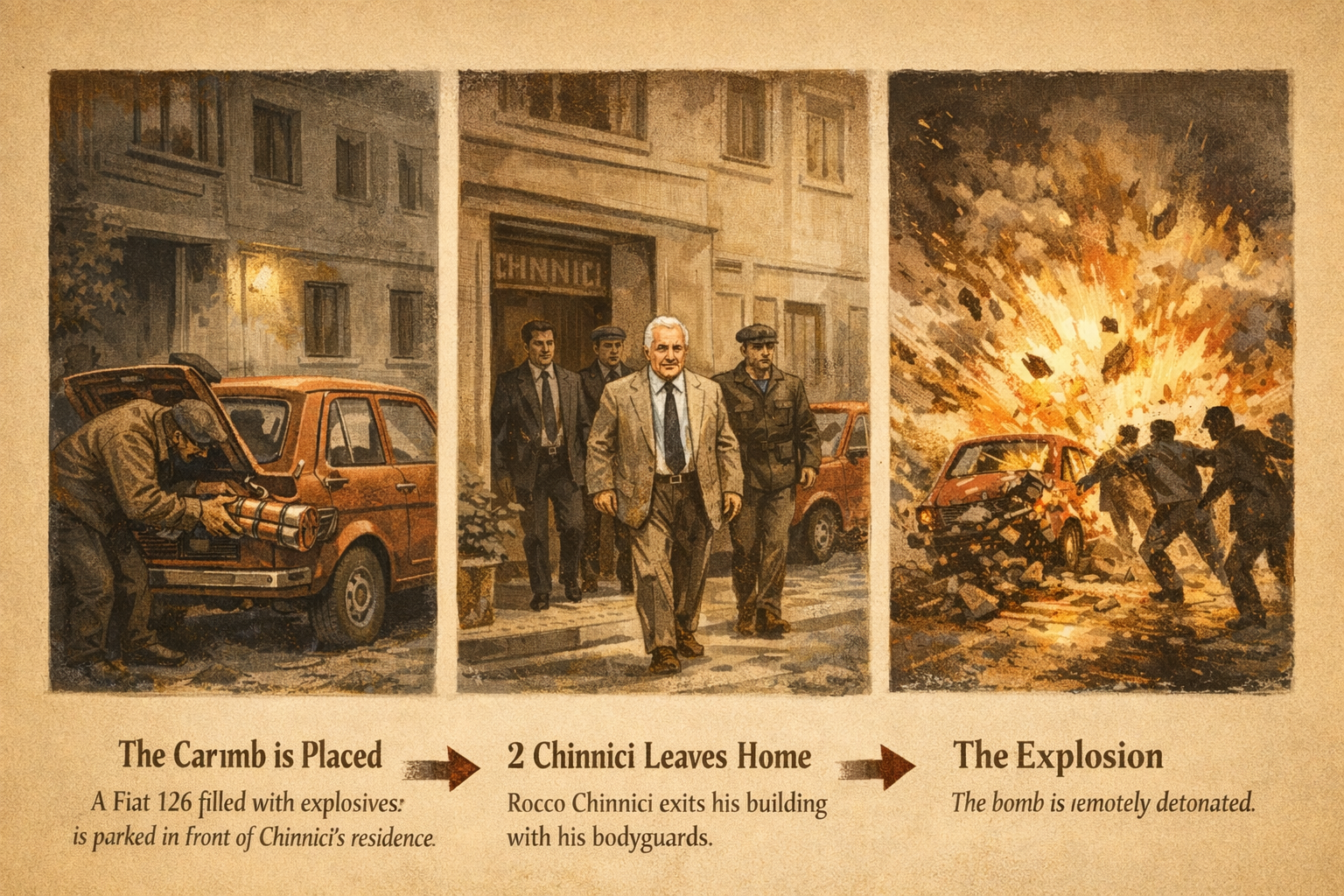
The attack was carefully planned. The explosive device had been placed inside a parked car and detonated remotely at the moment Chinnici left his home. The force of the blast devastated the street, damaging nearby buildings and spreading fear across the city. It was not only an assassination, but a demonstration of power, a public act designed to show that Cosa Nostra could strike anywhere, even in the heart of Palermo.
Chinnici had laid the foundations of what would later become the Antimafia Pool, introducing a method based on coordination between magistrates, shared investigations, and a unified vision of Cosa Nostra. It was a turning point in the fight against the Mafia, and it made him a target. For the first time, a magistrate was trying to dismantle the Mafia not case by case, but as a system.
For years, the truth behind the attack remained unclear, buried within fragmented testimonies and evolving investigations. The complexity of the case reflected the difficulty of penetrating the internal structure of the Mafia at that time. Only later did the judicial process begin to reconstruct the chain of responsibility.
In 2000, the leaders of the Mafia Commission were sentenced to life imprisonment as the masterminds of the bombing. Among those identified as perpetrators were Giovanni Brusca, Calogero Ganci, Giovan Battista Ferrante, and Francesco Paolo Anzelmo, some of whom later became collaborators of justice. In 2003, the Supreme Court confirmed the convictions, closing one of the most significant chapters of the investigation.
Investigators also pointed to the involvement of Nino Salvo and Ignazio Salvo, powerful figures whose economic and political interests had come under Chinnici’s scrutiny. This aspect highlighted another dimension of the attack: it was not only about eliminating a magistrate, but about protecting a network of power that extended beyond traditional criminal activity.
The Via Pipitone bombing was not just an assassination, but a message. It was a warning to those who tried to understand the Mafia, to those who attempted to fight it as a system, and to those who believed it could be dismantled through law.
At the same time, it marked a shift in Mafia strategy. The use of a car bomb in a residential area showed a willingness to escalate violence and to accept collateral victims. This method would later be used again in attacks such as the Capaci massacre and the Via D’Amelio massacre, confirming a pattern of increasingly open confrontation with the State.
Rocco Chinnici was among the first to follow this path, and others would continue it after him. His work influenced magistrates such as Giovanni Falcone and Paolo Borsellino, who would develop the method he had introduced and bring it to its highest level during the Maxi Trial.
Today, the assassination of Chinnici is remembered as a turning point. It exposed both the strength of the Mafia and the vulnerability of those who opposed it, but it also marked the beginning of a new phase in the fight against Cosa Nostra.
A phase in which understanding the system became the first step to dismantling it.
A visual reconstruction of the attack
The assassination of Rocco Chinnici was carried out with a car bomb placed in front of the building where he lived in Palermo. This illustration offers a visual reconstruction of the attack: the explosives hidden inside a Fiat 126, the judge leaving his home with his escort, and the devastating blast that killed him, the bodyguards Salvatore Bartolotta and Mario Trapassi, and the building’s porter Stefano Li Sacchi.
That explosion did not just kill a judge.
It tried to erase a vision.